
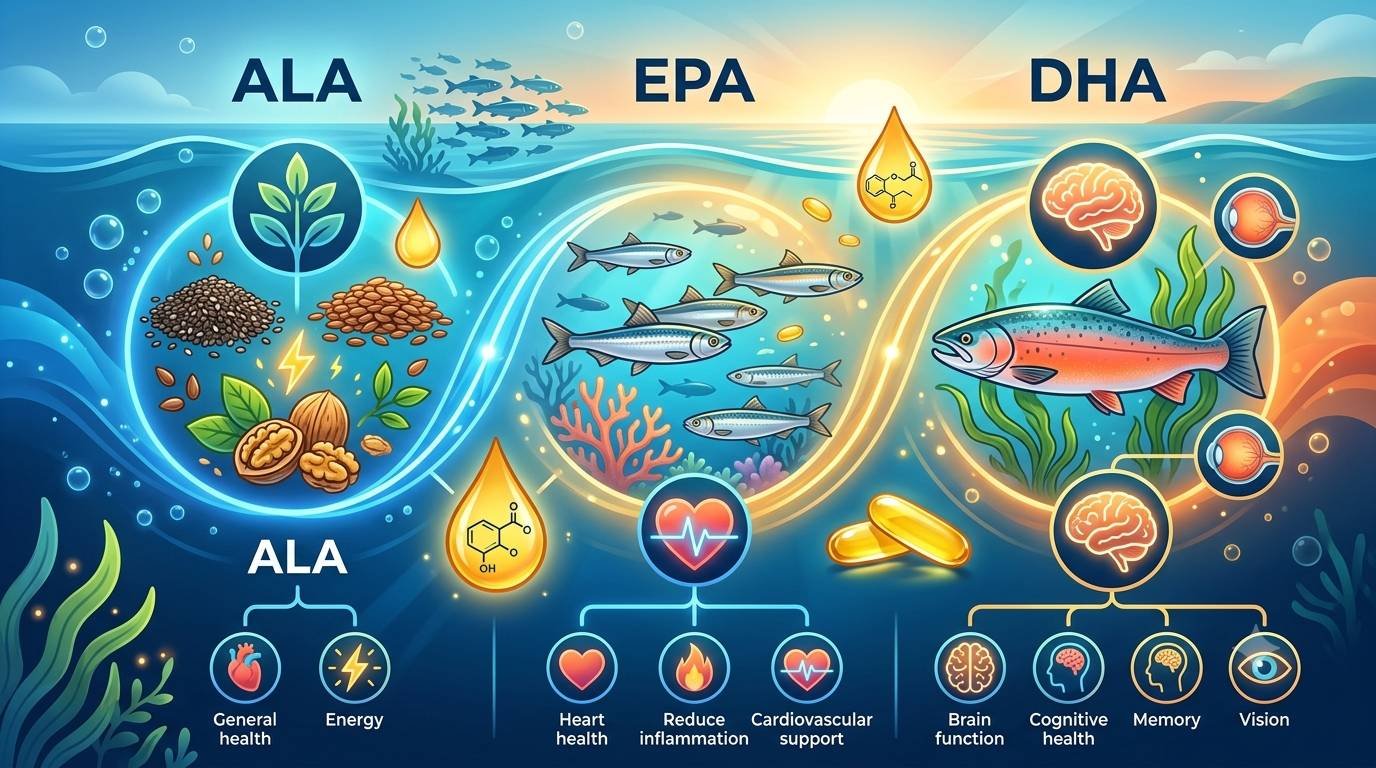
Omega-3 fatty acids are often presented as a simple wellness essential, but the category is more complicated than a bottle of “fish oil” might suggest. Omega-3s include several different fatty acids, and the three most important ones are ALA, EPA, and DHA. They have different food sources, functions, and evidence behind them.
Understanding those differences makes it much easier to decide whether you need an omega-3 supplement, what type may suit you, and what to look for on the label.
This guide breaks down the science in practical terms, from EPA and DHA to plant-based algae oil, dosage, freshness, purity, and third-party testing.
What Are Omega-3 Fatty Acids?
Omega-3s are a family of polyunsaturated fats that play important structural and biological roles throughout the body. The three that receive the most scientific attention are:
- ALA (alpha-linolenic acid): Mainly found in plant foods.
- EPA (eicosapentaenoic acid): Found primarily in fatty fish and seafood.
- DHA (docosahexaenoic acid): Also found mainly in fatty fish and seafood and is especially concentrated in the brain and retina.
ALA is considered an essential fatty acid because the body cannot make it on its own. EPA and DHA can be produced from ALA, but the conversion is limited. For that reason, eating EPA- and DHA-rich foods or using a supplement is the practical way to increase these long-chain omega-3s.
EPA vs. DHA vs. ALA: What’s the Difference?
The biggest mistake when shopping for omega-3 supplements is treating every omega-3 as interchangeable.
ALA: The Plant-Based Omega-3
ALA is found in foods such as:
- Flaxseeds and flaxseed oil
- Chia seeds
- Walnuts
- Soybean oil
- Canola oil
ALA is important for normal nutrition, but the body converts only a small proportion of it into EPA and DHA. That means eating flax or chia is excellent for increasing ALA intake, but it does not provide the same direct source of EPA and DHA as fatty fish or algae oil.
EPA: Often Associated With Cardiovascular Health
EPA is a long-chain omega-3 found in foods such as salmon, sardines, herring, mackerel, and other seafood.
EPA is involved in cell signaling and inflammatory processes. Research on omega-3s has also examined EPA for cardiovascular health, particularly in people with elevated triglycerides or specific cardiovascular risk factors.
Importantly, research on prescription-strength EPA products should not automatically be used to make claims about an ordinary over-the-counter fish-oil supplement. The dose, formulation, and patient population can be very different.
DHA: Important for the Brain and Eyes
DHA is a major structural component of cell membranes and is particularly abundant in the brain and retina. This makes DHA especially relevant to neurological and visual function.
DHA is also important during periods of development, which is why it receives considerable attention in pregnancy and infant nutrition.
The key takeaway is simple: ALA, EPA, and DHA are related, but they are not identical nutrients.
Where Can You Get Omega-3s From Food?
Food is an excellent starting point for getting omega-3s.
Rich Sources of EPA and DHA
Fatty fish generally provide the most concentrated dietary sources, including:
- Salmon
- Sardines
- Mackerel
- Herring
- Tuna
The amount can vary considerably depending on the species, diet, farming conditions, and serving size.
Good Sources of ALA
For plant-based omega-3s, consider:
- Ground flaxseed
- Chia seeds
- Walnuts
- Canola oil
- Soybean oil
A varied diet can provide ALA along with protein, fiber, vitamins, minerals, and other beneficial compounds.
What Health Benefits Does Omega-3 Have?
Omega-3s are involved in many biological processes, but the strength of evidence varies depending on the specific outcome.
Cardiovascular Health
EPA and DHA have been extensively studied in relation to cardiovascular health and blood triglyceride levels.
However, it is misleading to say that taking any omega-3 supplement automatically prevents heart disease. Results from clinical trials vary based on the formulation, dose, population, and health status of participants.
For people with very high triglycerides, prescription omega-3 products may be used under medical supervision. These should not be confused with standard dietary supplements.
Brain Health
DHA is an important component of brain tissue. Because of this, researchers have studied omega-3s for cognition, aging, mood, and neurological health.
The biological importance of DHA does not mean that a supplement will necessarily improve memory or prevent cognitive decline in every healthy adult. Marketing claims often go beyond what clinical evidence can establish.
Eye Health
DHA is highly concentrated in the retina and contributes to its structure and function. This is one reason DHA is frequently discussed in connection with visual health.
Again, structural importance should not automatically be interpreted as proof that higher supplemental doses improve eyesight in otherwise healthy people.
Joint and Inflammatory Health
EPA and DHA influence pathways involved in inflammation. Some studies have found benefits for certain inflammatory and joint-related outcomes, particularly in people with conditions such as rheumatoid arthritis.
But omega-3 supplements are not a universal replacement for medical treatment. They should be viewed as one possible part of an overall health strategy.
Fish Oil vs. Algae Oil: Which Is Better?
If you want EPA and DHA, fish oil and algae oil are two common options.
Fish Oil
Fish obtain their omega-3s through the marine food chain, ultimately from marine algae. Fish-oil supplements therefore provide EPA, DHA, or both.
Advantages include:
- Widely available
- Usually provides both EPA and DHA
- Many formulations and strengths
- Extensive research history
Potential drawbacks include:
- Not suitable for people avoiding animal-derived marine products
- Quality can vary between manufacturers
- Poorly handled oils can oxidize
- Sustainability is an important consideration
Algae Oil
Algae are the original source of marine EPA and DHA in the food chain. Algae-based supplements provide a direct, plant-derived marine source of omega-3s.
Algae oil can be particularly useful for people following vegetarian or vegan diets. Many products focus primarily on DHA, although some provide EPA as well.
The better option depends on your needs. Rather than choosing based only on the words “fish oil” or “vegan,” check the actual EPA and DHA amounts on the label.
How Much Omega-3 Do You Need?
This is where supplement marketing can become confusing.
There is no universally established recommended daily intake for EPA and DHA for healthy adults. Official guidance does establish adequate intake levels for ALA. For adult men, the ALA adequate intake is 1.6 grams per day, while for adult women it is 1.1 grams per day.
For supplements, avoid assuming that more is automatically better.
The FDA has concluded that dietary supplements providing no more than 5 grams per day of combined EPA and DHA are safe when used as recommended. Higher doses should not be treated as routine self-care, particularly because high-dose omega-3 therapy can have specific risks and may require medical supervision.
Some large clinical trials have also reported a small increase in atrial fibrillation risk with 4 grams per day of omega-3 supplements in people with cardiovascular disease or elevated cardiovascular risk.
A Practical Approach
For general wellness, don’t start with a high-dose product simply because the label promises a stronger effect.
Instead:
- Look at your dietary intake first.
- Identify whether you specifically want EPA, DHA, or both.
- Check the amount of EPA and DHA rather than the total fish-oil weight.
- Follow the product’s serving instructions.
- Speak with a healthcare professional if you need a therapeutic dose.
Read the Supplement Label Carefully
A bottle might say “1,000 mg fish oil”, but that does not mean it contains 1,000 mg of EPA and DHA.
For example, a serving could contain:
- Fish oil: 1,000 mg
- EPA: 180 mg
- DHA: 120 mg
- Other fatty acids: 700 mg
In this example, the relevant EPA+DHA amount is 300 mg, not 1,000 mg.
This is why the most useful numbers on an omega-3 label are the actual amounts of EPA and DHA per serving.
What Else Should You Check?
Look for:
- EPA amount
- DHA amount
- Total servings
- Source of the oil
- Form of omega-3
- Lot or batch information
- Expiration or best-before date
- Storage instructions
- Third-party quality testing
Don’t choose a product simply because the front of the bottle says “high potency.”
Understanding Omega-3 Forms
You’ll encounter several forms of fish oil, including triglyceride, re-esterified triglyceride, and ethyl ester forms.
These differences can affect how the oil is processed and absorbed, but they should not distract from the more basic questions: How much EPA and DHA are actually present, and has the product been properly manufactured and tested?
A premium-sounding chemical description does not automatically make a supplement better.
Oxidation: Why Freshness Matters
Omega-3 fats are chemically prone to oxidation. Exposure to oxygen, heat, light, and poor storage conditions can contribute to deterioration.
This is particularly relevant because fish oil can develop an unpleasant rancid odor or taste when it has oxidized.
How to Reduce Oxidation Risk
Choose products that:
- Have a reasonable expiration date
- Come from manufacturers with strong quality controls
- Are packaged appropriately
- Provide storage instructions
- Do not have an unusually strong rancid smell or taste
After opening, follow the manufacturer’s storage instructions carefully. Refrigeration may be appropriate for some products, but the label should be your first guide.
A fishy burp alone does not prove that a product is rancid. Flavorings and the formulation can also affect taste.
Purity and Contaminant Testing
Because fish live in marine environments, consumers often worry about contaminants such as heavy metals and persistent environmental pollutants.
Reputable manufacturers use purification and testing processes to control contaminants. Independent verification can add another layer of confidence.
For example, the USP Dietary Supplement Verification Program includes facility audits, manufacturing documentation review, laboratory testing, and ongoing off-the-shelf testing. Its verification addresses whether products contain their labeled ingredients and meet specified quality requirements, including limits for certain contaminants.
When shopping, look for credible third-party quality programs rather than relying solely on a manufacturer’s own claims.
What About IFOS and Other Quality Certifications?
Third-party testing can be useful because the manufacturer is not the only party evaluating the product.
Depending on the market and product, you may encounter quality programs or certifications associated with:
- Purity
- Potency
- Oxidation
- Contaminant levels
- Manufacturing quality
- Label accuracy
One important distinction is that a certification or testing mark should be understood for what it actually verifies. A quality seal does not automatically mean that the supplement provides every health benefit claimed in its advertising.
Quality assurance and clinical effectiveness are two different questions.
Sustainability Matters Too
Fish-oil production raises environmental questions because marine resources are finite.
When sustainability matters to you, consider:
- Whether the manufacturer identifies the fish species used
- Whether the company provides information about sourcing
- Whether fisheries are responsibly managed
- Whether the product uses byproducts or dedicated fish harvests
- Whether an algae-based option could meet your needs
Algae oil can be an attractive option because it obtains omega-3s directly from algae rather than relying on fish as the source.
Sustainability claims should still be evaluated carefully. Look for specific sourcing information instead of vague phrases such as “eco-friendly.”
Common Omega-3 Marketing Claims to Question
The omega-3 market is full of impressive-sounding promises. A little skepticism can save you money.
Be cautious with claims such as:
“Supports everything from your brain to your joints.”
Omega-3s do have multiple biological roles, but that doesn’t mean a supplement prevents or treats every condition.
“More EPA and DHA means better results.”
Higher doses are not automatically better for everyone.
“Pharmaceutical grade.”
This phrase can sound authoritative but should not replace checking actual testing, ingredients, and regulatory status.
“Ultra pure.”
Ask what purity means and whether independent testing supports the claim.
“Best omega-3 for everyone.”
There is no single formulation that is ideal for every person.
The best supplement is the one that matches your dietary needs, health goals, preferences, and appropriate dose.
Who May Want to Consider an Omega-3 Supplement?
A supplement may be worth discussing with a healthcare professional if you:
- Rarely eat fish or seafood
- Follow a vegan or vegetarian diet and want a source of DHA or EPA
- Need a specific EPA/DHA intake for a medical reason
- Have dietary restrictions that make food sources difficult
- Have been advised by a healthcare professional to use one
For many people, however, supplements are not the first step. A balanced diet that includes appropriate omega-3-rich foods can provide important nutrients along with the fatty acids themselves.
Who Should Be More Careful?
Omega-3 supplements are generally well tolerated, but they can cause side effects such as fishy aftertaste, heartburn, nausea, stomach discomfort, diarrhea, or headache.
People taking medications that affect blood clotting should discuss omega-3 supplementation with a healthcare professional. This is especially important if considering higher doses.
The same applies to people with medical conditions, those preparing for surgery, pregnant or breastfeeding individuals, and anyone considering therapeutic doses.
A Simple Omega-3 Buying Checklist
Before purchasing a supplement, ask these questions:
- How much EPA does one serving contain?
- How much DHA does one serving contain?
- Am I looking at fish-oil weight or actual EPA+DHA?
- Is the product independently tested?
- Does the manufacturer provide quality and sourcing information?
- Is there a clear expiration date?
- Does the product have appropriate storage instructions?
- Does the formulation match my dietary preferences?
- Am I buying it for general nutrition or a specific medical purpose?
- Have I discussed it with a healthcare professional if I take medication or need a high dose?
This approach is much more useful than choosing the bottle with the biggest number on the front.
Frequently Asked Questions
Is ALA as good as EPA and DHA?
ALA is an important essential omega-3, but it is not interchangeable with EPA and DHA. The body converts ALA into EPA and DHA only to a limited extent, so direct dietary sources of EPA and DHA are more practical for increasing those specific fatty acids.
Is fish oil better than algae oil?
Neither is automatically better. Fish oil commonly provides EPA and DHA, while algae oil provides a marine, plant-derived source and can be useful for people avoiding fish products. Compare the actual EPA and DHA amounts rather than choosing based only on the source.
Should I take omega-3 with food?
Taking an omega-3 supplement with a meal is a practical choice and may improve tolerance for some people. Follow the product’s directions, particularly if the formulation has specific instructions.
Does more EPA and DHA mean greater health benefits?
Not necessarily. Omega-3 effects depend on the dose, formulation, health outcome, and individual circumstances. High doses should not be used simply because a larger amount sounds more effective.
How do I know if fish oil has gone bad?
A strongly rancid smell or unpleasant taste can be a warning sign of oxidation. However, mild fishy taste or burping does not necessarily prove that the oil is spoiled. Proper storage and checking the expiration date are important.
Can I get enough omega-3 from food?
Yes. Many people can obtain omega-3s through a varied diet that includes sources such as fatty fish, flaxseed, chia seeds, walnuts, and certain plant oils. Whether supplementation is useful depends on your diet and individual needs.
Conclusion
Omega-3 supplementation becomes much easier to understand once you stop treating “omega-3” as a single nutrient. ALA, EPA, and DHA have different sources and roles, and the body does not convert ALA into EPA and DHA efficiently enough to make them completely interchangeable.
For most people, the smartest approach is to start with food, identify what you actually need, and then evaluate supplements based on their EPA and DHA content, quality testing, freshness, sourcing, and appropriate dosage.
Don’t let a large number on the front of a bottle make the decision for you. Read the Supplement Facts panel, look for credible quality verification, and separate legitimate evidence from marketing language. And if you’re considering high doses or take medications that could interact with omega-3s, get professional advice first.
A good omega-3 supplement should not need exaggerated promises to make its case. Clear labeling, transparent testing, sensible dosing, and credible evidence are far more valuable.